Showing posts with label 2012. Show all posts

Friday, 17 August 2012

A close look at the future of Indian economy


United Nations, Economic and Social Survey of Asia and the Pacific (ESCAP) report outlines defining factors that project growth and stability of Indian economy and surrounding regions in the Asia-Pacific.For India, ESCAP puts forward a positive outlook for increased GDP growth in 2012 as compared to 2011.


Inflation remains one of the key things to watch out for in 2012. Until recently RBI has increased raise policy rates 13 times in 19 months. For the first time in many months, the policy rate was reduced by50 basis points, hinting towards an easing monetary policy. As the government and RBI loosen their death grip over monetary and fiscal policies, ESCAP has a positive outlook for growth in 2012.


On the brighter side, despite tighter monetary policies that directly impacted personal consumption and demand, GDP grew by 6.9% in 2011. The ESCAP survey talks about reducing the impact of inflation on the poor by strengthening the government’s already existing policies to increase distribution of food items at subsidized prices.

Fiscal and budget deficit are challenges that India Inc will have to deal with rigorously. The government has already put targets in place to reduce budget deficits, however failed to achieve them for 2011 due to higher than expected expenditures.

The ESCAP survey acknowledges that the growth in trade deficit combined with depreciation of the rupee against the dollar have contributed to the slowdown in India in the last few years.
While all this does not happen overnight, India has taken massive strides in the field of solar energy. On the upside, more than 10 solar parks have been either completed or commissioned in various stages throughout India in the last 2 years.


The Indian government is currently promoting development and use of solar energy by moves such as reducing custom duties on solar PV panels, acknowledging investment in renewable energy projects and even giving subsidies of up to 70% for investments in solar PV plants in certain areas.


On an aggregate basis, inflation, soaring energy costs and poverty are dragging on the economy which grew 6.9% in 2011.


Energy shortage was also highlighted as possible deterrent to a fiscal surplus on which Kaushik Basu, Chief Economic Advisor to the Government of India, said "If the global prices are high for a product that is imported there is no way you can totally shelter the population. If you shelter it by holding that price completely constant, it appears that you are sheltering customer… but you are building on your fiscal deficit" The report talks about measures like reducing power theft, increasing exploration of oil and gas and developing renewable energy resources.
Source: ESCAP Survey
www.tradingeconomics.com

Friday, 29 June 2012

Economy and Realty at glance- June 2012


GDP at a nine year low of 6.5%, high inflation at 7.55%. Ironically, in the fight between taming inflation and propelling growth, we are losing out on both


- Revenues of top-25 realty companies declined 9.30% in Q4FY12, mainly on account of low sales off-take due to higher prices and higher mortgage rates.

- The Realty Index on Bombay Stock Exchange (BSE) has dropped by more than 26% during the last one year compared to a 10% fall in the Sensex during the last fiscal year. In order to bring back the enthusiasm of the investor community into the sector, real estate companies will have to focus on factors such as improving cash flow position, lowering inventory, reducing debt and increasing profit margins

- RBI in its mid quarter review of monetary policy in June reaffirms that cheap interest rate is a far-fetched expectation in the wake of high inflation rate

- During the March 2012 quarter, interest cost as a percentage to sales stood at 15% compared to only 8% reported during the March 2010 quarter

- Although international crude oil price has declined by 20% since the beginning of the last fiscal year, the price of domestic fuel has gone up because the depreciation in Indian currency against USD by 25% during the same period has made import of crude oil expensive

- The Indian Rupee has depreciated by 18%, 8% and 32% against the British Pound, Euro and Yen respectively. Hence, a stubbornly high inflation rate will defer a lower interest rate regime

The World this Week June 18 - June 22 2012

Monday, 14 May 2012

What the UPA govt can learn from B.E.S.T

"Ek bandra station," I told the conductor of the B.E.S.T (BrihanMumbai Electric Supply and Transport) bus number 83, handing over a ten rupee note. "Do rupiya aur," he replied. "12 rupiya ka ticket hai?" I asked him. "Ji sir," he replied.


I was travelling from Century Bazar in Worli to Bandra. The ticket till very recently used to cost eight rupees. It has now been increased to Rs 12, a rather steep 50 per cent increase.

The prices of tickets of lower denominations haven't been increased so much. A four rupee ticket is now five rupees. But at the same time a ten rupee ticket now costs fifteen rupees and a twelve rupee ticket costs eighteen rupees. This got me thinking. Why had the B.E.S.T increased prices? Well for the simple reason that they had to match their income with their expenditure, which is the most basic thing that needs to be done for successfully operating any institution.

The fact that it is not allowed to raise prices as often as it probably wants to has led to this very high increase. While the B.E.S.T believes in at least trying to ensure that its income meets its expenditure, the United Progressive Alliance (UPA) which runs the government of India, doesn't. And this is neither good for the UPA nor for you and me, the citizens of India.

In the year 2007-2008 (i.e. between April 1, 2007 and March 31,2008) the fiscal deficit of the government of India stood at Rs 1,26,912 crore (Rs 1,269.12 billion).

Fiscal deficit is the difference between what the government earns and what it spends. For the year 2011-2012 (i.e. between April 1, 2011 and March 31, 2012) the fiscal deficit is expected to be Rs 5,21,980 crore (Rs 5,219.80 billion). Hence the fiscal deficit has increased by a whopping 312 per cent between 2007 and 2012. During the same period the income earned by the government has gone up by only 36 per cent to Rs 796,740 crore (Rs 7,967.40 billion).

Things cannot be quite right when your expenditure is expanding nine times as fast as your income. As Franklin Roosevelt, who was the President of America for a record four times, between 1933 and 1945 famously said "Any government, like any family, can, for a year, spend a little more than it earns. But you know and I know that a continuation of that habit means the poorhouse."

So why is the UPA led Indian government headed to the poorhouse?  For that we have to dig a little deep and look into this document known as the annual financial statement of the government of India. In this document the government gives out numbers for the amount it had assumed initially as the oil subsidy for the year, and the final oil subsidy it gave.

The data for the last three years has been very interesting. The subsidy assumed at the time of the finance minister presenting the budget has always been much lower than the final subsidy bill. Take the case for the year 2009-2010 (i.e. between April 1, 2009 and March 31,2010) the oil subsidy assumed was Rs 3,109 crore (Rs 31.09 billion).

The final bill came to Rs 25,257 crore {(Rs 252.57 billion) direct subsidies + oil bonds issued to the oil companies}, around eight times more. The next year (i.e. between April 1, 2010 and March 31, 2011) the oil subsidy assumed was Rs 3,108 crore (Rs 31.08 billion).

The actual bill was nearly 20 times more at Rs 62,301 crore (Rs 623.01 billion). For the year 2011-2012(i.e. between April 1,2011 and March 31,2012) the subsidy assumed was Rs 23,640 crore (Rs 236.4 billion). The actual subsidy bill came to Rs 68,481 crore (Rs 684.81 billion).

So in each of the last three years the oil subsidy bill has come out to be greater than what was assumed. For the current financial year (i.e. April 1, 2012 to March 31,2013) the oil subsidy bill has been assumed to be at Rs 43,580 crore (Rs 435.80 billion). While this is greater than the assumption made over the last three years, it is highly likely that the oil subsidy bill will come to amount greater than this.

There are two reasons for the same. The first reason is that the rupee has been rapidly depreciating against the dollar and since oil is sold in dollars that means that the Indian companies are paying up more in rupees to buy the same volume of oil. Currently oil is priced at around $115 per barrel (around 159litres) of oil. This means that Indian companies pay around Rs 6,141 per barrel of oil.

If the rupee falls further and one dollar equals Rs 60 (as has been written about on this website), the Indian companies will be paying Rs 6,900 or 12.4 per cent more per barrel of oil.

In the normal scheme of things this cost would have been passed onto the customer and everybody would have lived happily ever after. But that is not the case. Various products coming out of oil like kerosene, diesel etc, are heavily subsidized in India. Hence even with higher prices of oil internationally the Indian oil companies will have to keep selling their products at lower prices and suffer losses. These companies are then compensated for the losses they face by the government of India.

The second reason is that the price of oil is unlikely to go down in dollar terms as well. As governments and central banks around the world run close to zero interest rates and print more and more money (and are likely to continue to do so) in order to revive economic growth in their respective countries, oil has become a favourite commodity to buy among the speculators.

While central banks and governments can print all the money they want, they can't dictate where it goes. As  Ruchir Sharma writes in Breakout Nations - In Pursuit of the Next Economic Miracles "When money is loose, investors borrow to buy hard assets, which is why the prices of oil, copper, and other commodities have become disconnected from actual demand."

This means that oil will either continue at its current price level or even go up for that matter. And with the rupee likely to depreciate further this means that India's oil import bill is likely go up even further.

It is highly unlikely that this increase in price will be passed onto the end customer. This means that the government will have to bear the losses incurred by the oil companies, pushing up the oil subsidy, which has been assumed to be at Rs 43,580 crore (Rs 435.80 billion). A higher oil subsidy bill means the government expenditure going up and this in turn means a higher fiscal deficit.

Typically, the government finances this deficit by borrowing money. With the government needing to borrow more money it would have to offer a higher rate of interest. At the same time a higher government borrowing will crowd out private borrowing, meaning that the private borrowers like banks and other finance companies will have to offer a higher rate of interest on their deposits because there would be lesser amount of money to borrow.

A higher rate of interest on deposits would obviously mean charging a higher rate of interest on loans. All this can be avoided if the government follows what B.E.S.T did recently i.e. allow oil companies to raise prices of its products.

Why can't a free market operate when it comes to oil products? If the price of oil products changes on a daily basis depending on its international price, like the price of vegetables, people will gradually get used to the idea of a changing price for products like diesel and kerosene. And of course chances are that with the government borrowing coming down, interest rates might also fall.

In 2007, when the government fiscal deficit was low, a 20 year home loan could be got at an interest rate of 8 per cent. A loan of Rs 25 lakh (Rs 2.5 million) would mean an EMI(equated monthly installment) of around Rs 25,093. Manybanks are now charging their existing consumers around 13 per cent on their home loans.

This means an EMI of around Rs 35,147 or almost 40 per cent more. The huge subsidy on oil prices has had a role to play in this increasing EMI. Bad economics does not always mean good politics. Its time UPA woke up to that.


Thursday, 29 March 2012

Investing in 2012 by Mr. Swapnil Pawar, CIO of Karvy Private Wealth

Investment avenues for 2012 can be recommended based on careful assessment of various scenarios that may pan out. The emphasis is more on action rather than on communicating  a certain "outlook". I believe the investors are often flooded with too much "outlook" and too little "actionable input". Here is an attempt to focus on the matter.

I have used what is typically referred to as scenario-building exercise. This is a powerful technique implemented by military planners, oil explorers and geo-political experts. Simply put, according to scenario analysis, the final shape of the world is a function of a few key drivers. These drivers affect the intermediate variables, which, in turn, shape the future. The important factor to consider here is the parallel impact of a given driver on different variables. Thereafter, we can easily come down to a fairly small list of candidate scenarios of how the world would shape up.


Using scenario analysis, we are trying to overcome 2 common problems typically faced in our endeavor of investment advice too specific and inherently speculative prediction on one hand, and too general and anything-can-happen sort of pseudo-prediction on the other. Real life is hard to predict. The attempt , therefore, is to forecast as few different alternative futures as possible, and design an investment strategy in that light. 

Thursday, 19 January 2012

2012: The year of new normals


The year 2011 was the second-worst for the BSE Sensex since 1980. India also turned out to be the second-worst performing market among the Asia pacific emerging markets in 2011. This was a year when the resilience of the Indian economy got challenged by both internal and external factors.

That said, the bulk of the pain was self-inflicted. The correction in the markets in the last quarter was more due to India-specific issues, such as lack of policy measures, corruption, and monetary tightening. Moreover, GDP growth continues to slow down. Meanwhile, foreign investors are increasingly concerned about the mid-term direction this country is taking with increasing susbidies and populist measures.

We believe that going forward, markets will reconcile to a lower trend growth rate- and settle at 6.5-7%. This could be the new nromal for growth and, by global standards, is not a bad number at all. We expect inflation to come down this year- it could average around 7%, leading to a nominal growth of 13-14%. That would lead to corporate earnings growth of 15%. Meanwhile, the rupee has weakened significantly this year, and we expect 50 levels to be the new normal. Exporters will benefit big time from this rupee weakness.

We expect growth to bottom out in Q1CY12, at 6%. Corporate earnings should also bottom out around this time. We expect the RBI to start easing the monetary policy, with a potential repo rate action on January 24 itself. Going by history, equity markets typically bottom out around the time when interest rates peak out. We expect markets to bottom out in Q1CY12 itself.

Globally, things are not as bad as perceived in August. In the US, there is no double-dip. In Europe, the endgame will require the European Central Bank (ECB) coming into play, which, we believe, will happen sooner than later. We expect equity market returns of 20-25% , backed by 10-15% earnigs growth and a P/E re-rating from 12x to 14-15x once growth bounces back to 7%.

Varun Goel
Head-PMS
Karvy Private Wealth

Saturday, 5 March 2011

5 Smartest Computers of the World!


Supercomputers are super achievers with the most extraordinary performances at any given time.
Supercomputers are used for highly calculation-intensive tasks such as problems involving quantum physics, weather forecasting, climate research, molecular modeling and physical simulations.

Today's supercomputers eventually turn into tomorrow's ordinary computers. Work is on to build the fastest supercomputer by 2018.

1.IBM Deep Blue:

The fastest computer to ever play chess is the IBM Deep Blue which was created in the year 1997.
The machine beat world champion Garry Kasparov when it won a six-game match on May 11, 1997.
The event was captured live only on the website, where millions of chess and computing fans tuned in to witness the event in real-time.


2.Stratus and Cirrus(backup):

The world's best supercomputers, Stratus and Cirrus are used by the US National Weather Service for the most accurate weather forecast.It has upgraded the supercomputer to develop weather forecast models, a system so critical to meteorologists that the government has bought a second, identical system as a backup.Stratus has a speed of up to to 0.07 petaflops.


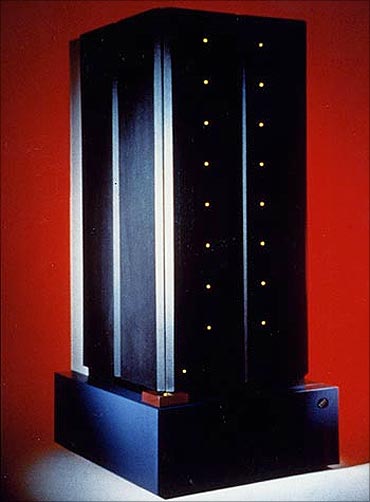
3.The Connection Machine:

The Connection Machine was originally intended for applications in artificial intelligence and symbolic processing, but later versions found greater success in the field of computational science.
The CM-5 in the film is one of only two built by the Thinking Machine Company -- one is at Los Alamos and the other, in the movie, was sold to the NSA.This computer can achieve 65.5 gigaflops of computations per second. The Connection Machine was originally intended for applications in artificial intelligence and symbolic processing, but later versions found greater success in the field of computational science.


4.Hopper:

The world's fifth fastest supercomputer, Hopper was named after Admiral Grace Hopper, a pioneer in software and programming languages.The Hopper runs at 1.05 petaflops (trillion operations) per second and works on energy research.


5.Tsubame 2.0:

The Tokyo Institute of Technology announced that their Tsubame 2.0 machine will begin operation this fall.
Tsubame 2.0 is built to hit the 2.4 petaflop level using mixed technologies from Intel, HP, NVIDIA and contracting from NEC. Japan's Tsubame 2.0 is the fourth fastest supercomputer in the world and the fastest in Japan.The computer can calculate 2,400 trillion times per second, or 12 times faster than a supercomputer at the Japan Atomic Energy Agency.


Source: http://www.rediff.com/business